10 games and apps that make revision painless
In September, the good resolutions; by November, reality. The problem with revision is almost never the method: it is getting started. Hence this list: games and apps where you genuinely revise — historical landmarks, vocabulary, definitions — without ever feeling like you are working. The principle that ties them together: 10 minutes a day beat 2 hours on a Sunday, and memory holds on better when you test yourself than when you re-read.
Our selection runs from apps to completely free ideas. We make the first one (Junban) and we have described it with the same criteria as the others.
1. Junban — history landmarks without the flashcards
Free, iOS and Android · history, mental maths, general knowledge
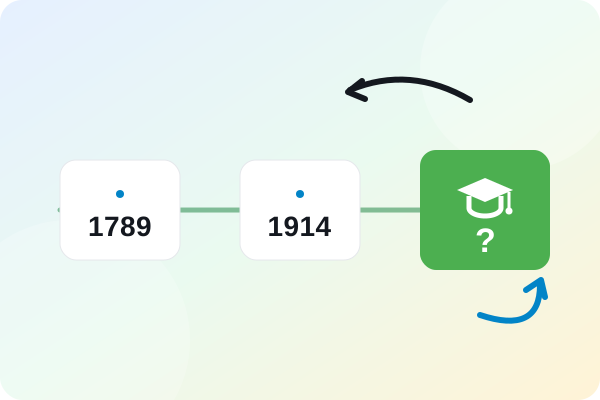
History exams assume the one thing nobody wants to learn by heart: chronology. Junban builds it through play: does this event happen before or after the previous one? The French Revolution before or after American independence? No dates to recite — and yet, game after game, the timeline settles into place, exactly the one your essays need.
The themes go beyond history: inventions, scientific discoveries, literature, country populations, and a mental maths mode where you compare the results of calculations. The ranked solo mode turns the bus ride into a voluntary revision session — probably the only moment of the day when revising feels like a game.
2. Anki — the spaced repetition of medical students
Free (paid on iOS) · memorisation: dates, vocabulary, definitions
The flashcard app that medical students live by, perfectly usable from high school: each card comes back just before you would forget it — that is spaced repetition, the most effective known algorithm for memorisation. Dates, philosophy definitions, foreign vocabulary, formulas: everything that must stay in long-term memory goes in. Austere on the surface, but the daily streak quickly becomes a game against yourself.
3. Quizlet — flashcards in game mode
Free with options · every subject
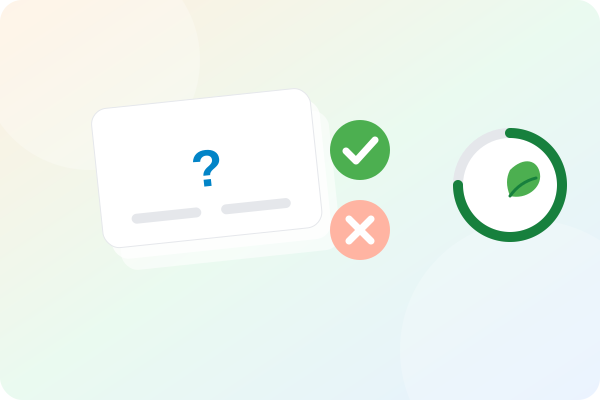
The same principle as Anki, more playful and more social: timed game modes, auto-generated tests, and above all millions of shared decks — search for your chapter, odds are another student has already turned it into cards. Building your own deck remains the best revision: writing the question is already answering it.
4. Kahoot! — the study group that never dozes off
Free · revising together before a test
The projected quiz your teachers already use — except it works even better between friends: everyone prepares ten questions on a chapter, then you run each other's quizzes. Whoever writes the questions revises twice; whoever answers gets tested. A study group with a leaderboard never falls asleep.
5. Duolingo — a language as a daily streak
Free with options · languages
The reference in gamification: three-minute lessons, a daily streak you dare not break, and a mascot more guilt-inducing than any teacher. It does not replace lessons, but it manufactures the one thing that genuinely improves a language: consistency.
6. Categories, exam edition
Free · every subject
The categories game, curriculum edition: replace "first name, animal, fruit" with authors, philosophers, key dates, capitals, irregular verbs. A random letter, three minutes on the clock, two points per unique answer. Play it with your study group — arguing over whether an answer counts is already revision.
7. Timeline — the chronology laid out on the table
~£13 · history, inventions
The card game where you place events relative to each other: the same principle as Junban, in a physical version. The cards do get memorised eventually — its well-known limit as a game, and a genuine asset here: memorising the chronology is precisely the goal. Our detailed comparison explores the difference.
8. The Feynman technique, game edition
Free · the whole curriculum
Explain the lesson in two minutes flat to someone who knows nothing about it — a parent, a friend taking other subjects. They score a point every time they say "wait, I didn't get that". If you cannot explain it simply, you do not know it yet: that is the Feynman technique, and it is the most reliable pre-test check there is.
9. Forest — gamified focus
~£4 · the study session itself
Not a revision game, but the game that makes revision possible: you plant a virtual tree, it grows for 25 minutes… and dies if you touch your phone. By the end of term, the forest tells the story of your work sessions. The Pomodoro technique, made harder to betray.
10. Original version — English without revising
Free · languages
The most pleasant method on this list: switch your series and sagas to original version with subtitles. The ear adjusts within weeks, vocabulary follows, and re-reading Harry Potter in English remains the classic move for a level that takes off effortlessly. Our guide to what order to read and watch Harry Potter in can serve as the syllabus.
Which subject, which tool?
| To work on | The tool to try |
|---|---|
| History and chronology | Junban or Timeline |
| Memorisation: dates, definitions, formulas | Anki or Quizlet |
| Languages | Duolingo + original version |
| This week's test | A Kahoot! with your study group |
| Focus | Forest |
| Checking a chapter is truly known | The Feynman technique |
The real secret is in no single app: it is active recall — testing yourself rather than re-reading — and short, regular practice, ten minutes a day at a fixed moment. Every game above is simply active recall disguised as a match.
👉 Discover Junban, on iOS and Android — your first game takes less than a minute.
To go further: the 10 best family quiz games and our methods for improving your music knowledge.